
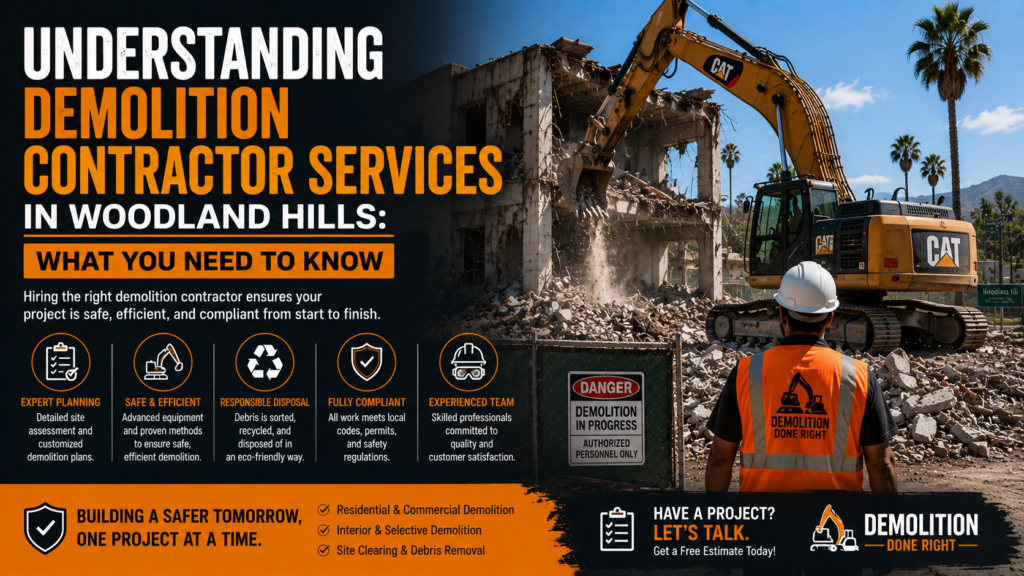
Woodland Hills, nestled in the western San Fernando Valley of Los Angeles, is one of Southern California’s most dynamic and evolving residential neighborhoods. With its mix of mid-century architecture, sprawling ranch-style homes, and a growing wave of modern infill construction, Woodland Hills has long been a community in active transformation. As properties age, renovation projects multiply, and new development footprints expand across the area, the role of the demolition contractor in Woodland Hills has become increasingly important. But what exactly does a Demolition Contractor Woodlands Hills do, and why is understanding their craft so essential for property owners and developers in this area?
What Is a Demolition Contractor?
A demolition contractor is a licensed professional who specializes in the safe, systematic, and regulated dismantling of structures whether those are entire buildings, single rooms, concrete slabs, retaining walls, swimming pools, or interior spaces. Unlike general contractors who build things up, demolition contractors break them down in a controlled, deliberate way that protects the surrounding environment, neighboring properties, and the people working on site.
In Woodland Hills specifically, demolition contractors must operate in compliance with the City of Los Angeles building codes, environmental regulations governing hazardous materials (such as asbestos and lead paint), California OSHA requirements, and local noise and dust ordinances. This is not a job that amateur or unlicensed workers can safely or legally perform at scale.
Types of Demolition Services Common in Woodland Hills
Demolition is not a one-size-fits-all process. In a neighborhood like Woodland Hills, which features everything from post-war bungalows to sprawling multi-family properties, demolition contractors are called upon for a diverse range of services:
Total Structural Demolition: This involves the complete razing of a structure down to its foundation. Common in Woodland Hills when aging homes are being replaced with new construction or when fire-damaged properties need full removal. Heavy machinery such as hydraulic excavators, bulldozers, and skid steer loaders are deployed, and debris is systematically hauled away for disposal or recycling.
Selective and Interior Demolition: Often called a “soft strip” or partial demo, this approach removes specific components walls, flooring, kitchens, bathrooms, ceilings while leaving the structural shell intact. This is particularly relevant in Woodland Hills where homeowners are undertaking renovations to modernize older properties without full rebuilds.
Pool and Spa Removal: Woodland Hills homes frequently feature pools that have become liabilities rather than assets. Demolition contractors remove pool shells using either full excavation (total removal) or partial fill-and-crush methods, depending on permit requirements and future plans for the land.
Concrete and Hardscape Demolition: Driveways, patios, retaining walls, sidewalks, and foundations require specialized equipment including jackhammers, concrete saws, and high-reach excavators to remove safely. This type of work is common as Woodland Hills homeowners reconfigure outdoor spaces.
Commercial Demolition: Woodland Hills has a significant commercial corridor along Ventura Boulevard and Warner Center. Demolition contractors handle tenant improvement demolitions, shell strip-outs, retail remodels, and occasionally full building teardowns for commercial redevelopment.
Hazardous Material Abatement: Given the age of many structures in Woodland Hills many built in the 1950s through 1970s the presence of asbestos in insulation, floor tiles, and pipe wrapping is common, as is lead paint in older structures. Certified demolition contractors coordinate asbestos and lead abatement before any major demolition begins.
Why Proper Planning Matters Before Demolition Begins
One of the most commonly asked questions about demolition work is: What preparation steps should happen before the process begins? In Woodland Hills, as in any Los Angeles neighborhood, the sequence of preparation is critical. Utility disconnections must be coordinated with gas, electric, and water providers well before work begins. Asbestos and lead surveys are typically legally required for structures built before 1980. Permits must be pulled from the City of Los Angeles Department of Building and Safety. Neighboring property owners should be notified, and protective measures like dust screens and vibration monitoring may need to be established.
A well-prepared demolition site in Woodland Hills also considers site access. Many residential streets in this neighborhood are narrow, and maneuvering heavy equipment requires careful logistics planning. Experienced demolition contractors conduct site assessments specifically to anticipate these challenges.
Demolition Methods and Equipment Used in Woodland Hills
The methods and equipment a demolition contractor selects depend on the size, complexity, and location of the project. Manual demolition uses hand tools like sledgehammers, reciprocating saws, and pry bars ideal for interior work or projects requiring precision. Mechanical demolition employs excavators, bulldozers, and hydraulic attachments that can bring down structures efficiently. For highly targeted structural removal, specialized techniques such as concrete cutting and coring are used. In densely residential areas like Woodland Hills, low-vibration and low-noise demolition methods are often prioritized to minimize disruption.
Sustainability and Material Recycling in Modern Demolition
A growing trend in the demolition industry and one that is particularly significant in environmentally conscious Southern California is the emphasis on sustainable demolition practices. Rather than sending all debris to landfill, responsible demolition contractors in Woodland Hills sort and divert materials for recycling and reuse. Concrete is crushed and recycled into base material. Steel is salvaged and sold as scrap. Wood framing may be donated or repurposed. Cabinets, fixtures, and architectural elements are increasingly being preserved and redirected to reuse outlets.
California has some of the strictest construction and demolition debris diversion requirements in the nation, and Woodland Hills contractors must demonstrate compliance with these regulations. This commitment to green demolition not only reduces landfill impact but can also result in project cost efficiencies.
Demolition as a Gateway to Transformation
In a neighborhood like Woodland Hills, demolition is rarely the end of the story it is the beginning of something new. Whether it is a homeowner finally tackling a long-delayed renovation, a developer clearing land for a modern multi-family building, or a commercial tenant reconfiguring a retail space, demolition creates the blank canvas that all future construction depends upon. The role of the demolition contractor is therefore foundational: they make everything else possible.
Understanding what demolition contractors do, how they operate, and what processes govern their work empowers property owners and developers to approach projects with greater confidence and clarity. In Woodland Hills, where the pace of property transformation continues to accelerate, that understanding is more valuable than ever.
Conclusion
Demolition in Woodland Hills is a precise, regulated, and multifaceted discipline. From full structural teardowns to careful interior strip-outs, from hazardous material abatement to sustainable debris diversion, demolition contractors in this Los Angeles neighborhood bring a broad set of skills and responsibilities to every project. As the community continues to grow and evolve, the expertise of skilled demolition professionals will remain central to how Woodland Hills reinvents itself one structure at a time.